




E-commerce and AI go hand in hand. AI helps online retailers increase sales and customer loyalty through personalized shopping and round-the clock chat service. AI powered assistants enhance customers’ likelihood of making a purchase by 25%, and personalized recommendations can boost revenue by up to 40%. Businesses that use AI report an increase in revenue of 10–12%. To put it briefly, AI technologies such as chatbots, machine learning, and personalization tools are now necessary for the expansion of e-commerce and client pleasure.
With AI, every click and scroll becomes a chance. Online shoppers of today need immediate assistance and highly customized experiences. This requirement is where artificial intelligence and e-commerce meet: AI-driven solutions use real-time customer data analysis to forecast trends, automate services, and make product recommendations. The outcome? more sales and quicker conversions. Businesses lacking these technologies run the danger of falling behind as the worldwide AI-ecommerce industry almost triples by 2032. This article examines the main ways AI is changing online shopping and how Glimstechnology, a top provider of IT and AI services, assists businesses in implementing these developments.
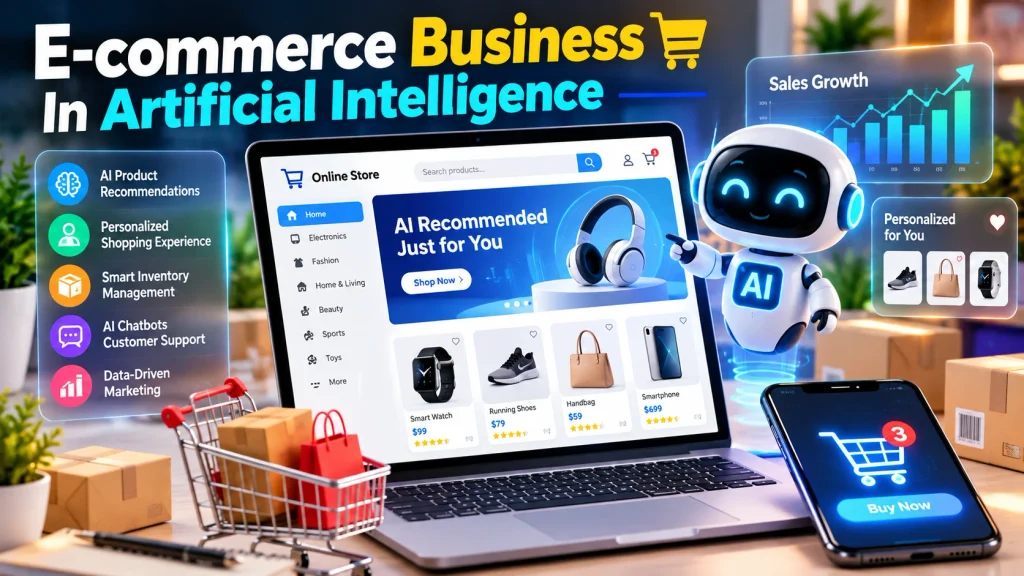
AI-Powered Customization: Beneficial to Both Buyers and Sellers
Consumers today yearn for relevance. AI systems monitor past browsing and purchasing activity to provide tailored product recommendations at every stage. Engagement is significantly increased by using the “right offer at the right time” strategy. Retailers that provide a personalized shopping experience, for instance, enjoy a 40% increase in sales. However, according to one survey, just 10% of shops currently completely utilize personalization, indicating a significant amount of unrealized potential.
Chatbots and virtual assistants that assist clients like a helpful salesperson are also made possible by AI. Natural language processing is used by these bots to respond to inquiries, make product recommendations, and even close deals. In addition to impressing clients, round-the-clock AI chat help frees up human agents to handle complicated problems. Customers who engage with AI assistants are really 25% more likely to make a purchase.
Did you know?
AI is currently a high goal for 84% of e-commerce companies, and “AI in e-commerce business” tools—such as personalized recommendation engines—are essential to that approach.
Among the main advantages of AI personalization are:
Increased Conversion:
Chat assistants and more intelligent recommendations encourage customers to check out (up to +25% conversion).
Increased Revenue:
Businesses who use AI find a 10–12% increase in revenue, and by cross-selling related products, they can increase the average order value.
Customer Loyalty:
Adding a personal touch makes buying more enjoyable and easy, which promotes repeat business and increased word-of-mouth.
In general, it is evident how artificial intelligence affects e-commerce companies: improved customer experiences result in actual income increases. From integrating product suggestion engines to deploying intelligent chatbots, Glimstechnology AI-powered solutions in Pakistan and elsewhere assist retailers in setting up this degree of customisation to spur growth.
Data & Automation: Using AI to Simplify Operations
Every user-friendly interface has a flurry of data behind it. AI simplifies the entire business, not just front-end wizardry. To improve pricing, forecasting, and supply chains, machine learning algorithms examine sales patterns, consumer behavior, and inventory levels. AI-driven analytics, for example, can reduce forecasting mistakes by 30–50% and optimize stock by 30–35% (making sure you have the proper products in stock). Because products are available when needed, these efficiencies result in cheaper prices and happy customers.
AI is also used by several retailers to automate marketing. Auto-personalized email and advertising campaigns are possible; AI determines which product to recommend to which customer and even when to send an email reminder. According to studies, 49% of merchants currently employ AI in marketing, particularly for dynamic advertisements and recommendation emails. Spending becomes more effective as a result. Top customization leaders increase marketing efficiency by 10–30%, according to McKinsey.
Did you know?
Businesses of all sizes can benefit from AI-driven commerce platforms, such as “headless” e-commerce systems. Nearly half of US businesses intend to utilize AI for marketing by 2025, and even 34% of Amazon sellers employ AI tools to create better listings and descriptions. E-commerce companies may now concentrate on expansion rather than just operations because to machine learning’s ability to analyze data. Integrating AI analytics is essential, as demonstrated by Glimstechnology managed IT and analytics services. Retailers cut waste and boost revenue by using AI for inventory management and data analysis.
Do you want to use insights from AI into your online business? Get in touch with us right now.
AI Assistants & Chatbots: Expanding Customer Support
E-commerce services are being advanced by amiable AI helpers. AI chatbots can immediately respond to common inquiries at any time of day, including order monitoring and product inquiries. Consumer use of chatbots has risen since 2020, suggesting that people increasingly anticipate prompt responses without having to wait. Crucially, AI assistants are viewed as a competitive benefit by 93% of e-commerce companies.
These bots use a combination of language models and machine learning to comprehend consumer intent and respond by consulting a knowledge base. Chatbots are becoming increasingly human-like as LLM (large language model) technology advances. These days, chatbots may even recover abandoned carts by re-engaging hesitant customers or upsell (“Did you want the premium version?”).
Did you know?
Overall client happiness with AI bots is still high, according to businesses. In actuality, automated bots have over 71% success rates and may resolve support tickets up to 18% faster. AI chatbots are revolutionary for small businesses because they offer round-the-clock assistance at a much lower cost than hiring a human. AI chatbots have a promising future in e-commerce; according to one statistic, 97% of businesses will soon have specialized AI teams. Glimstechnology assists companies in implementing top-notch chatbot solutions, guaranteeing that they collaborate seamlessly with human personnel to satisfy clients and increase revenue.
To learn how AI-driven solutions may assist more intelligent sales tactics, get in touch with Glimstechnology.

Future Trends: Voice, Generative AI, and the Next Wave
AI in e-commerce is developing quickly. Product descriptions, marketing material, and even advertisement pictures are already produced using generative AI techniques like GPT-style models. These advances produce new, captivating material instantaneously, whether it’s an AI tool that creates 3D product images or unique ad text.
Another frontier is voice shopping. As voice assistants (like Siri, Alexa, and Google) get better, consumers will be able to request things without using their hands. It is becoming increasingly important to optimize e-commerce sites for voice search (natural language inquiries). A consumer might say, “Alexa, add red running shoes to my cart,” for instance. AI needs to match products, understand context, and finish orders with ease.
Sophisticated personal shopping assistants are also made possible by large language models. Future assistants could ask, “What are your fitness goals?,” in place of a straightforward Q&A. I recommend these running shoes in light of that. Agentic AI is being tested by early adopters, and industry predictions indicate that by 2028, one-third of e-commerce businesses would employ autonomous AI agents (sellerscommerce.com).
All of this indicates that AI’s influence on sales and marketing will only increase. More impulsive purchases and increased engagement will result from AI-driven personalization and content production. The toolkit is being led by companies like OpenAI, Google, and AWS, but smaller vendors are also becoming more prevalent. Regardless of the source, it is evident that e-commerce businesses that use voice and generative AI generate buzz and FOMO, which boosts clicks and sales.
Are you interested in learning more about artificial intelligence in e-commerce and how it may boost sales? Let Glimstechnology assist you with these advancements by getting in touch with us right now.
Frequently Asked Questions
Q1: How do AI chatbots function in online retail?
AI chatbots utilize machine learning and natural language processing to comprehend consumer questions and deliver prompt answers. A chatbot may monitor order statuses, explore your product catalog, and automatically respond to frequently asked questions in an online store. The bot learns and gets better as users engage with it. These days, a lot of chatbots use large language models (LLMs) to have more human-like interactions, which helps them guide customers and even close deals.
Q2: Can actual customer care representatives be replaced by AI chatbots?
A: AI chatbots are excellent at mundane activities, such as responding to frequently asked questions, managing returns, or giving shipping information, freeing up human agents to handle more complicated problems. Although chatbots increase productivity and provide round-the-clock assistance, most companies employ them to supplement human teams rather than completely replace them. In actuality, a hybrid strategy frequently produces the greatest outcomes: the bot manages basic tasks and transfers control to a human when necessary. Bots will eventually be able to manage a greater variety of situations as AI develops, but human supervision is still crucial.
Q3: How does AI affect online shopping?
A: By enabling data-driven decision-making, boosting customer service, optimizing pricing, and improving personalization, AI has a big impact on e-commerce. AI helps businesses boost conversions, lower operating costs, and provide more customized shopping experiences through everything from product recommendations to demand predictions.
Q4: What AI application is utilized in online shopping?
Recommendation engines, chatbots, predictive analytics, dynamic pricing tools, visual search, and fraud detection systems are just a few of the AI applications used by e-commerce companies. These programs enhance overall sales performance, automate procedures, and evaluate consumer behavior.
Q5: Can AI take the place of online shopping?
AI can improve and optimize e-commerce, but it cannot completely replace it. Human creativity, planning, and decision-making are still crucial even as AI automates chores like customer service and product recommendations. Instead of completely replacing e-commerce operations, AI functions best as a tool to support them.

Comments are closed