



An architectural revolution is taking place in the software sector. Software-as-a-Service (SaaS) relied on relational database tables, static graphical user interfaces, and per-seat subscription licensing for more than 20 years. These days, autonomous operational engines are taking the place of passive data entry tools in AI-native software.
What Different AI-Enabled SaaS from AI-Native SaaS?
Large language models, autonomous agents, and vector databases are the foundation of fundamental application workflows built by AI-native SaaS. AI-enabled SaaS, on the other hand, does not change the core product economics or operational workflows; instead, it simply attaches conversational chatbots or third-party API wrappers to outdated relational databases and conventional CRUD structures.
Traditional software requires human operators to manually complete forms, navigate intricate menus, and initiate business processes. The software itself analyzes intent, retrieves contextual organizational information, produces outputs, and autonomously completes end-to-end multi-step activities in AI-native applications.
What Are the Price Differences Between Traditional and AI-Native SaaS?
AI-native SaaS substitutes outcome-based or usage-based pricing models that are directly linked to calculate consumption and business value for seat-based subscription tiers. Instead of paying for idle user licenses, customers pay for finished tasks, processed records, or workflow resolutions, directly connecting vendor revenue with customer operational productivity.
Charging per seat discourages customers from adopting software that does the actual work that was previously done by human employees. Innovative AI firms set their prices based on tangible business results, including the resolution of verified support issues, the reconciliation of invoices, or the generation of qualified leads.
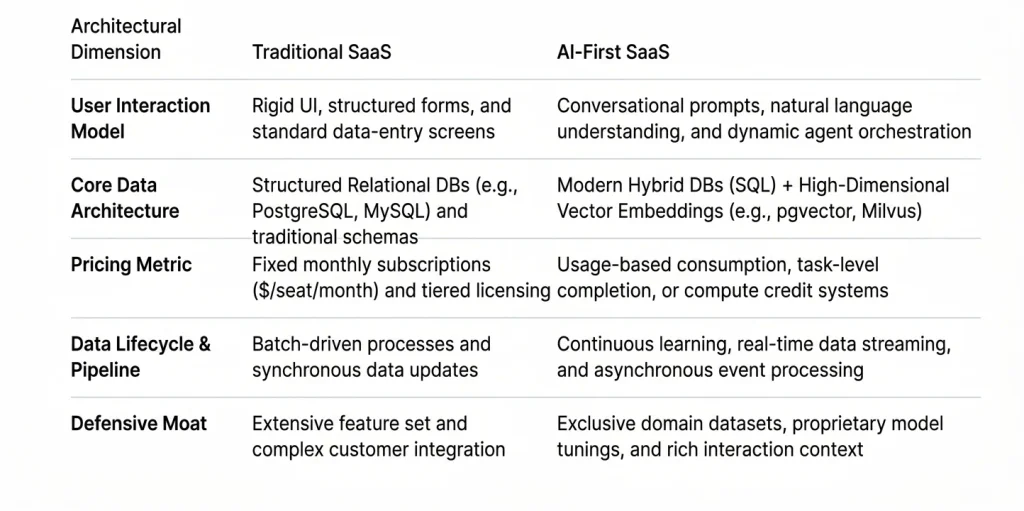
Architectural Comparison: Traditional vs AI-Native SaaS
The basic structural and financial distinctions between AI-native architectures and conventional cloud applications are shown in the table below:
The Power of the Architecture Stack AI-Native SaaS in the modern era?
High-performance web frontends like Next.js with FastAPI microservices, vector search engines like Pinecone or pgvector, and model orchestration frameworks like LangChain are all combined in contemporary AI-native SaaS designs. To avoid UI stalling, long-running inference processes are separated from client interfaces using distributed event queues like Redis or Kafka.
Essential Elements of the Stack:
Frontend Presentation: Server-Sent Events (SSE) are used by the React or Next.js App Router to stream tokens in real time.
Orchestration Layer: LlamaIndex, LangChain, and tool execution procedures are coordinated using Python FastAPI microservices.
Contextual Retrieval: RAG pipelines that combine BM25 keyword re-ranking with semantic vector search.
Strict row-level security (RLS) in multi-tenant database schemas prevents cross-tenant context leakage.
How Can AI-Native SaaS Avoid Runaway Token Costs?
Teams use query compression, accurate embedding deduplication, semantic prompt caching, and tiered model routing to stop runaway token expenses. High-cost frontier reasoning models are only used for complex edge cases requiring sophisticated analytical deduction; inexpensive lightweight models manage classification and intent routing.
Realistic Cost-Control Implementation Steps:
- To retrieve saved responses for identical semantic queries, use Redis-based semantic caching.
- Rather than delivering complete transcripts again, truncate discussion histories dynamically using rolling context summaries.
- Give lightweight models like GPT-4o-mini, Mistral, or Llama 3 easy classification and extraction tasks.
- Set automated alert levels and monthly token use restrictions for each customer organization.
Frequently Asked Questions
What Different AI-enabled SaaS from AI-native SaaS?
Large language models, autonomous agents, and vector databases are the foundation of fundamental application workflows built by AI-native SaaS. AI-enabled SaaS, on the other hand, does not change the core product economics or operational workflows; instead, it simply attaches conversational chatbots or third-party API wrappers to outdated relational databases and conventional CRUD structures.
What are the price differences between standard seat-based SaaS and AI-native SaaS?
AI-native SaaS substitutes outcome-based or usage-based pricing models that are directly linked to calculate consumption and business value for seat-based subscription tiers. Instead of paying for idle user licenses, customers pay for finished tasks, processed records, or workflow resolutions, directly connecting vendor revenue with customer operational productivity.
Which architecture stack drives contemporary SaaS apps that are AI-native?
High-performance web frontends like Next.js with FastAPI microservices, vector search engines like Pinecone or pgvector, and model orchestration frameworks like LangChain are all combined in contemporary AI-native SaaS designs. To avoid UI stalling, long-running inference processes are separated from client interfaces using distributed event queues like Redis or Kafka.
In AI-native SaaS, how do engineering teams stop uncontrollably high token costs?
Teams use query compression, accurate embedding deduplication, semantic prompt caching, and tiered model routing to stop runaway token expenses. High-cost frontier reasoning models are only used for complex edge cases requiring sophisticated analytical deduction; inexpensive lightweight models manage classification and intent routing.

Comments are closed